

What special requirements must business alarm systems meet?
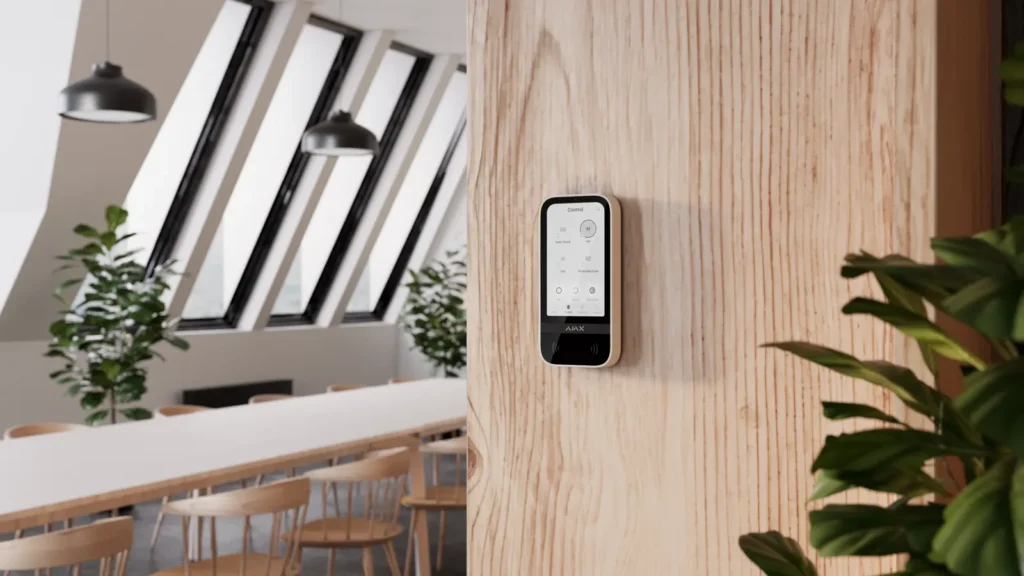
A business alarm system differs from a home installation mainly in the need to meet a security Grade, integration with employee access control, and the requirements of the property’s insurer. An office usually needs a different set of features than a warehouse or production hall, because the number of entrances, the value of the property, and the hours it’s left unattended all differ. At Defence System, we design systems for offices, hotels, service premises, and development projects, choosing the security grade and features for each specific risk profile.
In brief
- An office usually requires Grade 2 security, while warehouses and high-value properties require Grade 3.
- Many insurers require a certified system or offer a lower premium if you have one.
- Access control with a permission hierarchy lets you limit an employee’s access to designated zones only.
- Redundant communication via internet and SIM card keeps notifications flowing to the monitoring station.
How does a business alarm system differ from one in a single-family home?
A business system has to handle more users, more zones with different access levels, and usually longer periods when the property is empty and unattended. In a single-family home, one or two zones and a few users with the same permissions are usually enough, whereas an office needs separate access for reception, the server room, the conference room, and the executive office. Business installations also integrate more often with access control and video surveillance, because the alarm alone will scare off an intruder but isn’t always enough to fully assess the situation afterward. In addition, commercial properties are subject to security Grade requirements, which rarely matter in practice when choosing a home alarm system.
Which security Grade is required for an office, and which for a warehouse?
A small office or service business usually falls under Grade 2, while warehouses, office buildings, and properties with higher-value assets are classified as Grade 3. These security grades are defined by the PN-EN 50131 standard, which takes into account, among other things, device resistance to sabotage and how they respond to attempts to jam the signal. Higher grades use anti-masking detectors that detect attempts to cover or blind the device, as well as vibration detectors that react to attempts to force or smash, for example, a shop window. The safest way to determine the final grade is during an on-site visit, while also checking your own insurance policy, since it often specifies the minimum required level of security.
Certified system or any alarm: what does the insurer actually require?
Many insurers require a certified alarm system of the appropriate Grade as a condition of full coverage, and some also offer a lower premium when you can prove you have one. Any uncertified alarm can still deter a would-be intruder, but after a loss, the insurer may challenge the payout if the policy required a specific security grade. So the difference lies less in how well the alarm works day to day and more in formal proof of its compliance with the standard, which you can show during an inspection or a claim. Before signing or renewing a policy, check the exact wording about the required system grade, since different insurers and types of business may have different requirements.
Differences between certified and uncertified alarm systems for insurance purposes
| Aspect | Certified system (Grade class) | Uncertified system |
|---|---|---|
| Compliance with policy requirements | Usually meets the insurer’s terms | May not meet policy requirements |
| Claim payout after a loss | Formally confirmed compliance | Risk of being challenged by the insurer |
| Anti-sabotage features | Required in higher grades | Depends on the specific model |
How do you design an access hierarchy for employees in a business with several zones?
Designing an access hierarchy starts with dividing the property into zones that match real needs, for example a reception area open to everyone, a server room accessible only to the IT team, and an executive office for a limited circle of authorized people. Each employee gets access only to their designated zones, which makes it possible to track who enters which rooms and when, and to limit the consequences of a data leak or theft from a particular zone. The system also lets you manage guests by granting temporary access limited to common areas or a conference room, with no need to hand out physical keys or permanent cards. This setup works especially well in businesses with staff turnover or frequent visits from clients and partners, where managing traditional keys would quickly become confusing.
- Full-access zones: reception and common areas, open to all employees.
- Restricted zones: server room, archive, executive office.
- Temporary guest access: limited to selected rooms and a set time window.
Why does a business alarm system need redundant communication with the monitoring station?
Redundant communication, using both an internet connection and a SIM card, ensures that a threat notification reaches the monitoring station even if one of the channels stops working, for example because of an internet outage or a deliberately cut cable. In business premises, where the stakes include not only property but also server room continuity and access to records, losing one communication channel can’t mean losing protection altogether. The system automatically switches between channels while notifying the user that one of them has failed, so a repair can be planned before the second channel fails too. This approach to communication is one of the things that sets installations designed for businesses apart from simpler home systems, where a single channel is usually enough.
What role does a panic button play in business premises?
A panic button such as Button Jeweller lets you raise a silent alarm in a threatening situation without alerting the person causing the threat, which matters, for example, during a robbery at a checkout or reception desk. The signal goes directly to the monitoring station and to the phone of the person responsible for the property’s security, without sounding a siren that could escalate the situation instead of defusing it. In businesses with direct customer contact, such as service premises, hotels, or cash-handling points, such a button complements standard burglary protection, which mainly works outside business hours. Button placement is decided when designing the system, taking into account the places with a higher risk of contact with outsiders.
How do requirements change by industry: office, shop, hotel, or construction site?
An office mainly needs protection for entrances, the server room, and records rooms, with relatively regular working hours and predictable foot traffic. A shop or service business also needs protection for display windows and back rooms, while restaurants and hotels add access control for staff and temporary access for service technicians and suppliers, alongside standard fire protection. Development projects, meaning buildings under construction, need solutions that work without a constant mains supply or internet connection, with the ability to grant and revoke access at each stage as the number of contractors on site changes. The common denominator for all these industries is matching the system to the real risk profile of the specific property, not picking a ready-made kit regardless of its specifics.
Summary
- Business systems are subject to security Grades, usually Grade 2 for offices and Grade 3 for warehouses.
- A certified system can affect the terms and amount of your insurance premium.
- Access hierarchies and redundant communication with the monitoring station are typical of business premises.
- Requirements differ for an office, a shop, a hotel, and a building under construction.