

Where is the best place to install a water leak detector in a house?
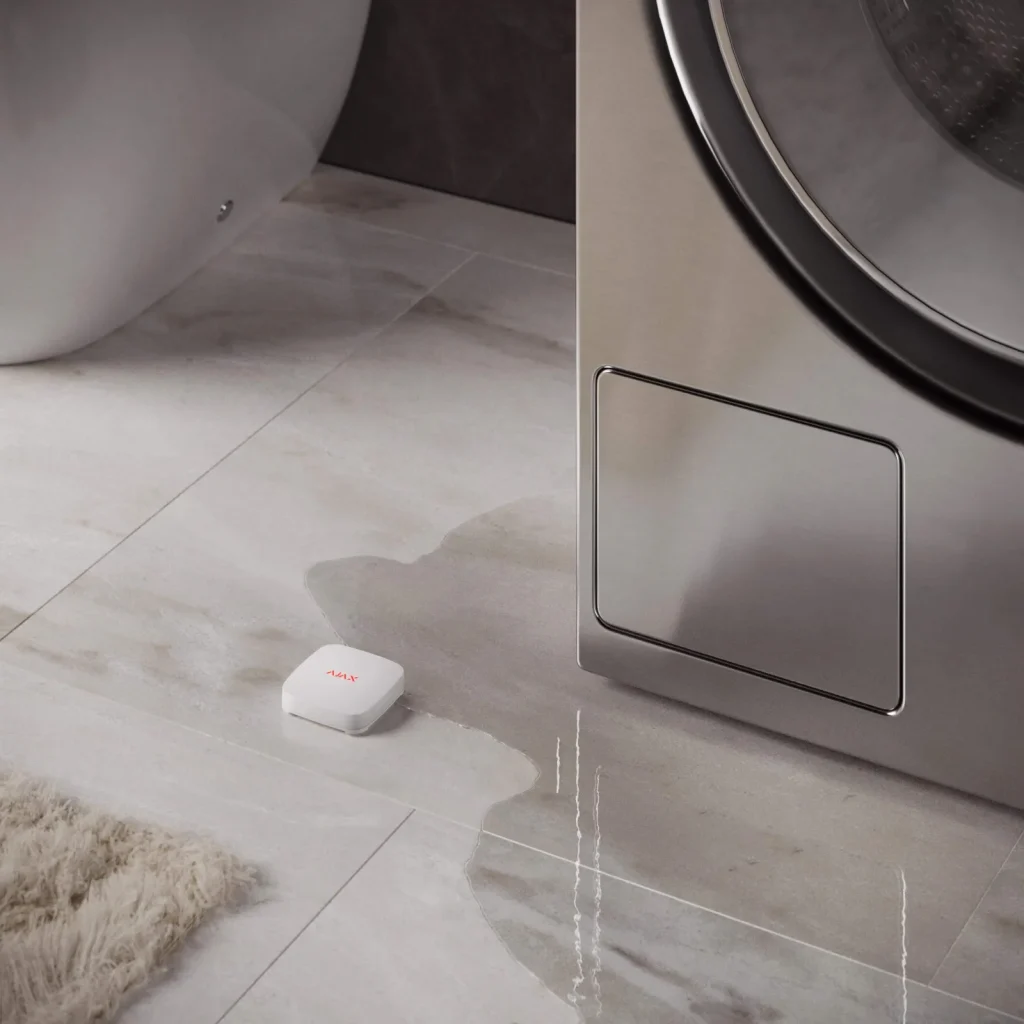
A water leak detector is best installed where a plumbing failure does the most damage and is hardest to notice right away: under the washing machine and dishwasher, by the water heater, and around the shower tray and toilet. These spots account for most reported floods in single-family homes. At Defence System, we match detector placement to the plumbing layout of the specific building, not to a ready-made template.
In brief
- The key installation spots are the bathroom, kitchen, laundry room, boiler room, and utility rooms.
- The detector senses water in a fraction of a second, and the push notification arrives within a dozen or so seconds.
- Integration with an automatic shutoff valve lets the water supply close within seconds of detection.
- The detectors work 24 hours a day and need no calibration in everyday use.
Which rooms in a single-family home need a water leak detector most?
The highest priority goes to rooms where water is in daily contact with plumbing and appliances: the bathroom, kitchen, laundry room, and boiler room. In the bathroom, the critical points are around the shower tray, tub, and toilet; in the kitchen, under the sink and dishwasher, where a leaky hose connection often shows up only after a few days. Boiler rooms and utility rooms with a water heater, boiler, or water and sewer lines need protection because of the scale of a potential failure. In buildings with a basement, it’s worth covering it too, because water flowing down from upper floors collects there first.
How high above the floor is a water leak detector mounted?
The detector is mounted directly on the floor or just above it, because its job is to detect water the moment it starts to spread. The device has electrodes that don’t conduct electricity under normal conditions and close the circuit only on contact with moisture, so every centimeter of mounting height adds to the time it takes to detect a failure. In practice, the detector goes at the lowest point of the room or directly under the appliance posing the greatest risk, such as a washing machine or a water heater tank. If the floor slopes toward a drain, it’s worth choosing the spot with the installer so the detector sits in the path of the flowing water, not off to the side.
Water leak detector or automatic shutoff valve: which should come first?
If you need to pick one solution to start with, begin with a leak detector, because it’s responsible for early detection and sends a notification before the damage spreads. An automatic water shutoff valve such as WaterStop Jeweller is the natural extension of this protection, because it closes the water supply automatically within seconds of the detector’s signal, with no manual intervention. You get full flood protection only when both work together in one programmed scenario. In homes where no one can respond to a notification right away, for example because of frequent travel, the shutoff valve matters more in practice than the notification alone.
The role of the water leak detector and the automatic shutoff valve
| System component | Function | Response time |
|---|---|---|
| Water leak detector | Detecting water and sending a notification | A fraction of a second after contact with water |
| Automatic shutoff valve (WaterStop Jeweller) | Physically shutting off the water supply | A few seconds after the detector’s signal |
How quickly will the detector spot water under a washing machine or dishwasher?
The detector reacts almost instantly: a thin film of water on the floor is enough for the electrodes to close the electrical circuit. The signal reaches the hub in a fraction of a second, and a push notification arrives on the user’s phone within a dozen or so seconds of the leak being detected. When a washing machine or dishwasher supply hose fails and the leak grows gradually, this response time lets you act before the water reaches neighboring rooms or soaks through the ceiling to the floor below. The sooner water is detected, the less repair work is needed afterward.
Is one detector enough for the whole bathroom?
In a typical bathroom, one detector is rarely enough, because the risk of leaks arises in several independent places at once, such as by the shower tray, tub, and toilet. It’s more effective to place a separate detector at each of these points so that a failure in one spot doesn’t go unnoticed because of its distance from a detector placed elsewhere. In larger bathrooms with a walk-in shower and a separate tub, the number of detectors grows in proportion to the number of higher-risk zones. We decide on the number of devices during the on-site visit, taking into account the layout of the fixtures and the direction water might flow.
- Around the shower tray or tub: the most common leak source when a seal is damaged.
- Next to the toilet: the risk of a leaking flush mechanism.
- Under the sink: monitoring the trap and water connections.
What happens if a leak occurs while nobody is home?
The alarm system works twenty-four hours a day, seven days a week, whether anyone is at home, at work, or on vacation. When water is detected, a push notification reaches your phone at any time, and if the detector is linked to an automatic shutoff valve, the water supply is closed automatically, with no action needed from the user. This matters especially in homes used seasonally or when the household is away for a long time and no one can physically close the main valve. That way, the damage is limited to a few seconds of leaking rather than the several days it might take for the household to return.
What do leak detector installation and setup look like in practice?
We start installation by analyzing the plumbing layout and pinpointing the places with the highest risk of failure, then choose a wired or wireless solution suited to each room. We integrate water leak detectors and the shutoff valve in one scenario on the hub, so that a detector sensing water automatically triggers the shutoff, with no delays from manual setup. After installation, the devices are maintenance-free, and the system monitors battery levels on its own and lets you know when a replacement is coming up. As part of our service, we regularly check that the whole flood protection system works correctly, including testing the valve’s response to the detector’s signal.
Summary
- The most important installation spots are the bathroom, kitchen, laundry room, boiler room, and utility rooms.
- The detector reacts in a fraction of a second, and integration with the WaterStop Jeweller valve shuts off the water within seconds.
- In larger bathrooms, it’s worth installing more than one detector, depending on the number of risk zones.
- The system works around the clock and protects your home even when no one is there.